|
The CDP Experience
From May 2006 to May 2007 the project prepared, in very close cooperation with the six participating service providers, namely Bac Ninh (May 06), Can Tho (June 06), Hai Duong (September 06), Soc Trang (October 06), Tra Vinh (December 06) and Vinh (May 07), comprehensive CDP reports, which illustrate the major strategies and activities of capacity building within the service providers, emphasizing the new challenges of wastewater management. Each CDP preparation workshop lasted about 10 days.
Apart from the director, heads of departments and staff representatives, other stakeholders such as the Provincial Peoples Committee (PPC), City Peoples Committee (CPC), Department of Natural Resources and Environment (DoNRE), Department of Construction (DoC) and Department of Finance (DoFi) were participating.
The preparation of the CDP content, including policies, strategies and activities, was elaborated in a highly participatory manner, involving all levels of managers and staff from within the service provider. Participatory methods, such as meta-plan, brainstorming, mind map, SWOT and TOWS, group work and participants’ moderation of working sessions, were applied.
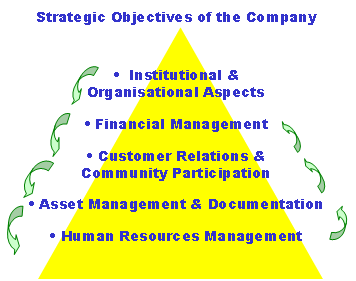
The CDP process was structured into 5 parts, representing the main strategic objectives of the service providers, namely “Organizational and Institutional Development”, “Financial Management and Tariff Setting”, “Customer Relations and Community Participation Management”, “Asset Management” (including “Asset Documentation”) and “Human Resource Management”.
Although this kind of participatory approach has hardly been applied in Vietnam before for public service providers and therefore raised some apprehensions, the participation during the workshops was, after a first phase of reservation, very active and productive. In general the CDP workshops can be viewed as a success in involving the doers and practitioners of the service providers into the assessment and planning process and as such contributing to the development of commitment and ownership among the service providers’ managers and operational staff. During all events, the method applied, was considered by all participants as a practical approach for developing their future internal analysis and plans.
|