Participatory Agricultural Extension
|
|
In the project area of the SMNR-CV, the livelihood of rural households critically depends on the effective use of agricultural land. Land, however, is a scarce natural resource in particular in the mountainous parts, where most households have less than 1.0 hectare to cover the subsistence needs of their families and – with increasing market integration – produce a marketable surplus for cash. Increasing the area under cultivation is not an option, since in most cases it would mean encroaching into forests on steep slopes with severe negative consequences for soil erosion. The intensification of farming, increasing the productivity while maintaining the fertility of soils, is thus the only option to increase agricultural outputs and to generate better incomes from farming. While irrigation systems are a technical solution for the lower parts of the region, they are often not feasible in the up-lands where the key problem remains the lack of knowledge and advanced agricultural techniques of the local population.
Similar to the system of socio-economic planning in Vietnam, the system of agricultural extension is rather ill equipped to address this key problem, since it is organized and works with a top-down approach and with little local adaptation to the specific physical and market conditions of local stakeholders. Under the leadership of the National Agricultural Extension Center (NAEC), the Provincial Agricultural and Forestry Extension Center (PAFEC) is the responsible entity for public agriculture extension services. The system extends to the District Agricultural Extension Stations (DAES) and ends on the commune level with the commune extension workers (CEW). The focus of the ´conventional agricultural extension service delivery is laid on “setting up models and transfer of advanced technologies”. This implies little or no consideration of technical training and exchange of experience among farmers. Participatory approaches and training based on market analysis and forecasts, and most importantly training based on the expressed needs of farmers are usually not part of the conventional system.
|
 |
|
|
Click to enlarge
|
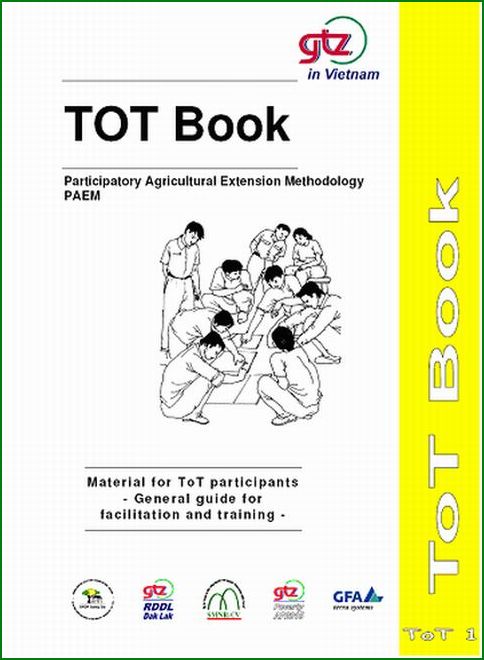
The SMNR-CV project, after carrying out an in-depth analysis of the prevailing farming systems in Quang Binh province, adopted the “Participatory Agricultural Extension Method” (PAEM) which was first applied by the “Social Forestry Development Project” (SFDP) in Song Da, carried out by GFA from 1993 to 2004.
In the first version of the PAEM guideline, issued jointly by the SFDP project in Song Da, The RDDL project in Dak Lak and the SMNR-CV, the PAEM concept is described as an approach how to practice participatory and farmer-led agricultural extension, and how to make sure that action and learning by doing can take place in the farmer’s field. The approach is based on the principle that farmers learn best by own experience. The PAEM approach promotes the interaction between farmers and extension workers aiming at improving a joint learning process.
In the first phase of the SMNR-CV the general approach to PAEM was adapted to the regional conditions in Central Vietnam and the specific conditions of Quang Binh. In close collaboration with extension staff on provincial, district and commune levels, the available training material on the methodology was simplified and applied in a first round of “Training of Trainers“ (ToT), cascading down from the provincial staff to the commune extension workers (CEW), who in their turn carried out training courses with farmers and reported their experience and the feed-back of farmers back to higher levels.
|
|
|
Based on the general PAEM approach and on the expressed needs of farmers, and in parallel to the first round of pilot trainings, a series of technical training modules were developed. Among others, these covered topics such as
- General communication skills of CEW
- Household economics
- Sloping Agriculture Land Technique (SALT)
- Cultivation techniques and Integrated Pest Management (IPM) for rice, maize, cassava, fodder grass, beans and peanuts
- Veterinary practices and animal husbandry for cattle and pigs
This first series of technical training modules were applied by CEW in pilot trainings and were revised several times to best suit the needs and levels of understanding of local farmers. They were eventually published in the name of the provincial Department for Agriculture and Rural Development (DARD) as the guiding training documents for agricultural extension all over the province. In our download section, these documents are uploaded in their Vietnamese language versions only. The English versions are available on request for reference.
|
|
|
|
Click to enlarge
|
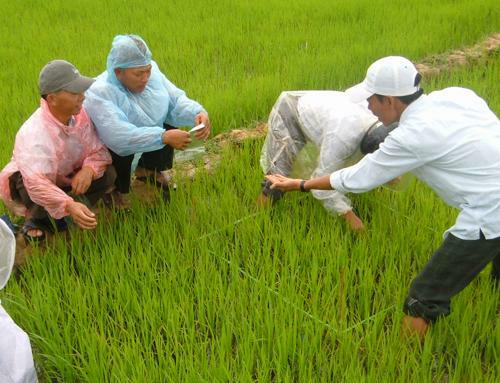
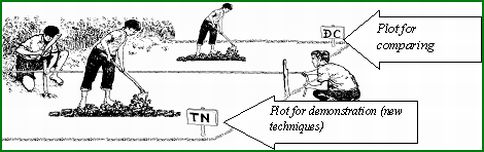
In parallel to the development of appropriate training materials, the SMNR-CV assisted the agricultural extension staff in revising their approach to agricultural field models in way that they became relatively small and simple field trials which can be replicated with the farmers’ own means. In practical terms, these field trials were integrated as demonstration plots into the technical trainings and became subject of farmer-to farmer visits. The package of innovative and participatory approaches to agricultural extension resembles the approach of “Farmers’ Field Schools”, as promoted by other organizations (e.g. FAO), but comes at a much lower cost. In view of tight public budgets for agricultural extension, the cost argument is seen as a decisive factor for the widespread application of PAEM and for a sustainable impact of the method.
In the logic of the impact chain, increased knowledge leads to improved agricultural techniques of the farming households, their adaptation to changing market conditions and eventually to increased net incomes. To verify these intended impacts, PAEM has recently been complemented by an impact monitoring system by which the commune extension workers carry out regular follow-up surveys on key parameters after each training and trial implementation.
The PAEM method has recently (July 2008) been officially integrated into the harmonized provincial strategy on agricultural extension. The application of the method has thus become mandatory in all districts and communes of Quang Binh province.
|
|
|
|
|
|
|
|






)
)

