|
|
|
|
|
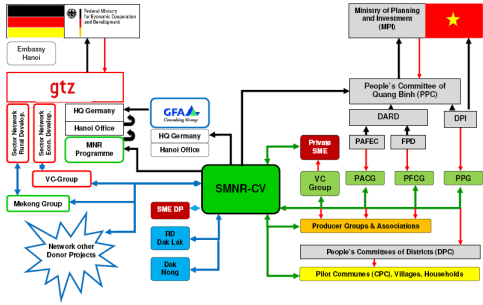
As a bilateral cooperation project, the SMNR-CV maintains intense working relations with its partners both on the Vietnamese as on the German side. In the illustration below, these relations are characterized by arrows which indicate either reporting duties (black), guidance or assistance (red), external networking (blue) or relationships as part of day-to-day project operations (green).
|
 |
|
|
Click to enlarge
|
Partners on the Vietnamese side
The “People’s Committee of Quang Binh” (PPC) is formally the “Project Owner” of the SMNR-CV. Based on regular meetings with the Project Management Board and reports by the Vietnamese Project Director, the steering function of the PPC concerns the major priorities and implementation strategies of the project, without getting involved in day-to-day operations. The PPC has seconded all necessary full-time project staff for the Vietnamese side, has equipped the project with 2 office buildings (including all operating costs), and provides all other support it has committed itself to in the bilateral agreement for the implementation of the project.
Until 2006, the role of “Project Owner” was formerly with the Vietnamese “Ministry of Planning and Investment” (MPI). In November 2006, the Government of Vietnam (GoV) issued the Decree 131/2006/ND-CP on the “Management and Utilization of ODA” which made it possible for decentralized administrative units (such as PPC of provinces and cities, provincial line departments, etc.) to assume full responsibility. However, decentralized project owners, such as the PPC of Quang Binh still report to the MPI on certain issues (such as on financial disbursements of ODA, representation in intergovernmental negotiations, etc.) and receive “guidance” on other more strategic issues. The institutional relations between the SMNR-CV and the MPI have thus weakened over the last couple of years. Personal contacts are, however, maintained.
Working relations with other ministries on the national level have at times been intense, depending on concrete requests and tasks, but are often indirectly channeled through other GTZ projects working on the national level. Examples are the support to the Ministry of Agriculture and Rural Development” (MARD) in the drafting of a revised legislation on forest protection, an ongoing support to a joint working group of MARD and the “Ministry of Natural Resources and Environment” (MONRE) in revising the legislation on forest land allocation, and the support to the “Ministry of Labour, Invalids and Social Affairs” (MOLISA) in the design of a large national program on poverty alleviation in 61 districts. – Even though these activities are limited in time, they are opportunities to provide bottom-up contributions and thus a certain leverage on national reform processes.
In Quang Binh province, key partners of the SMNR-CV on the operational level are the provincial line departments the “Department of Planning and Investment” (DPI) and “Department of Agriculture and Rural Development” (DARD). Most relevant sub-departments of the DARD are the “Forest Protection Department” (FPD) and the “Provincial Agricultural and Forestry Extension Centre” (PAFEC). Key personnel are the respective directors of these departments and their sub-departments as well as their leading technical officers. The achievability of more than half of the binding impact indicators of the project’s reference system depends critically on good working relationships with these partners.
With the support of the project, the relevant line departments have established so-called “Provincial Consultative Groups” which have become the focal points of cooperation in all working areas.
- The department of Planning and Investment (DPI) re-established the working group previously named “Village Development Group” as the “Participatory Planning Group” (PPG) with a more specific mandate and commitment to apply the new method of participatory socio-economic development planning (SEDP) in all communes and districts. After large scale pilot implementation in 4 rural pilot districts during 2007, the DPI issued in May 2008 the method as a binding official planning tool, the application of which is compulsory. As a milestone until 09/2008, all communes in all 7 districts elaborated their SEDP, based on participatory stakeholder workshops.
- The Department of Agriculture and Rural Development (DARD) has established the “Provincial Agricultural Consultative Group” (PACG) of Quang Binh province to assist its relevant sub-departments in the development, implementation and monitoring of participatory approaches of agricultural extension (PAEM), and to integrate these approaches into a harmonized provincial strategy on participatory agricultural extension. As a further output, a number of specific PAEM training materials have been published with the support of the SMNR-CV and are used in trainings of target groups by extension staff in every commune. In August 2008, DARD issued the official decision to integrate the PAEM as the core element of the provincial strategy and made its application compulsory.
- The Value Chain Promotion Group (VC Group) of Quang Binh province was established as a more informal group, not directly attached to any specific line department, but including members of relevant state organizations, producer associations and other private SME as well as a number of other donor financed projects and NGO. Even though (or perhaps because) this group is not as embedded in public institutions as are the other consultative groups, it has greatly contributed to changing the mind sets of its members in the direction of more market orientation, and has initiated a number of Local Economic Development (LED), cluster and value chain (VC) initiatives as well as Business Development Services (BDS) for Small and Medium scale Enterprises (SME).
- Also under DARD, but based on a decision of the PPC, the Provincial Forestry Consultative Group (PFCG) was established to provide advice to DARD and to the PPC of Quang Binh on general issues related to the development of the forestry sector in the province, and in particular related to the elaboration and implementation of the forest development plans and strategies. The PFCG maintains the principles of sustainable forest management, and has contributed to the introduction of innovative concepts of community forestry (including those developed by the SMNR-CV), improved market orientation by processing, trade and marketing to increase the value added of the forestry sector for pro-poor economic growth in Quang Binh.
Even though the focus of the project implementation strategy for Phase II is not on direct field implementation by project staff, but rather on the monitoring of large scale “roll out” done by its partners., the project continues to work directly in 7 remote rural pilot communes. Consequently, the administration of these communes (Commune People’s Committees, CPC) as well as the households and leaders of the villages in these communes (the so-called final target group) remain important cooperation partners of the SMNR-CV. Since in the local context these are “guided” by the districts, the District People’s Committees (DPC) and their technical sections indirectly also remain partners of the project.
|
|
|
Partners on the German side
Reporting duties on the German side include frequent informal exchanges and regular submission of project documents of the Chief Technical Advisor (CTA) to the headquarter of “GFA Consulting Group GmbH”, which in return provides administrative support (e.g. accounting) and technical back-up services.
The main line of “bottom-up” reporting on the German side is directed to GFA’s client, the “Deutsche Gesellschaft fuer Technische Zusammenarbeit” (GTZ). This relationship is based, for the SMNR-CV project as for others, on a “Consulting Contract” which stipulates rights and duties of both sides in detail. GTZ is a 100% state-owned enterprise (by the federal Government), based in Eschborn near Frankfurt am Main. It was founded in 1975 as a company under private law.
The Ministry for Economic Cooperation and Development (BMZ), as part of the German Federal Government is the donor of the German contribution to the project. The new desk officer responsible for Vietnam, who is a forester by professional background, has recently (November 2008) visited to the project area in Quang Binh and has expressed his appreciation of the achievements of GTZ in natural resource management.
In Vietnam, the German Development Cooperation in general and the GTZ projects in particular are organized in three sectors. The SMNR-CV project is part of the sector “Protection and Management of Natural Resources, Water and Sanitation”. Most GTZ projects in this sector (all but the program on water and sanitation) form the so-called “Green Group” or MNR-Group or MNR-Program on management of natural resources (for details, see the site http://www.mnr.org.vn/). The SMNR-CV project is an embedded part of the MNR-Program. The coordinator of the program is administratively responsible for the project on behalf of GTZ.
Other cooperation partners include informal networking relationships built up in recent years between the SMNR-CV and a number of other GTZ and GFA implemented projects, with several sector networks and working groups in Asia as well as with projects and organizations of other donors in Vietnam. With respect to intensive information exchange, only a selected few are highlighted here:
- The two “sister projects” of the SMNR-CV in the Central Highlands: “Rural Development in Dak Lak” (RDDL, see http://www.rddl-daklak.org/) and the project “Environmental Protection and Management of Natural Resources in Dak Nong (EPMNR). Both projects are implemented by GFA on behalf of GTZ, and both have similar concepts and methods. The RDDL has been implemented since 2003 and will finish by the end of 2009. The EPMNR has started only recently in May 2008 and is therefore interested in know-how transfer.
- Another project implemented by GFA on behalf of GTZ is the “Processing, Trade and Marketing of Forest Products” (PTM, see http://www.ptm.org.vn/) which is a component of the Vietnamese-German Forestry Program. The PTM has a sectoral focus on value chains in the furniture industry.
- The SME Development Programme (SME DP, see http://www.sme-gtz.org.vn/), implemented by GTZ in four pilot provinces, has become a cooperation partner of the SMNR-CV over the last years, notably in the areas of Local Economic Development (LED) and Value Chain Promotion.
- On the periphery of the external relations of the SMNR-CV are the GTZ sector networks Asia on Rural Development and on Economic Development. Every 2 years, both sector networks organize a general assembly with opportunities for information exchange.
- More informal are the sub-groups of the sector networks, namely the so-called “Mekong Group” of rural development projects in Vietnams, Laos and Cambodia; and the inter-sectoral Value Chain Group of GTZ projects in Asia. Both groups have regular biannual meetings which are well prepared and offer ample opportunities for information exchange among a peer group of experts from GTZ, consulting companies and other organizations.
- Last, there are the relations of the SMNR-CV with a network of other donor-financed projects and organizations of ODA, NGO and research institutions, notably in the project area in Central Vietnam. Even though all these relations are informal, they are a way to increase the outreach of project achievements, which means that other projects and organizations actively use and implement the innovative methods developed by the SMNR-CV on a much larger scale (“up-scaling). To mention just one example: The method of participatory “Village and Commune Development Planning” is now being applied as a standard method by projects of the ADB, Worldbank, IFAD, Sweden and other bilaterals (each with a financial volume of more than 30 million USD). The method is also taught at several Vietnamese Universities and Public Administration Academies.
|
|
|
|
|
|
|
|
|
|
|
|
|




)

