|
|

|
|
Click to enlarge
|
In the project region of the SMNR-CV, about 70 % of the land consists of forests, which makes it the most important natural resource, at least in terms of area coverage. Traditionally, these forests have been managed and/or protected by large scale State Forest Enterprises (SFE), which are, however, increasingly seen as not very efficient in their practices and in most cases exclude rural households from the potential benefits of sustainable use of forest resources.
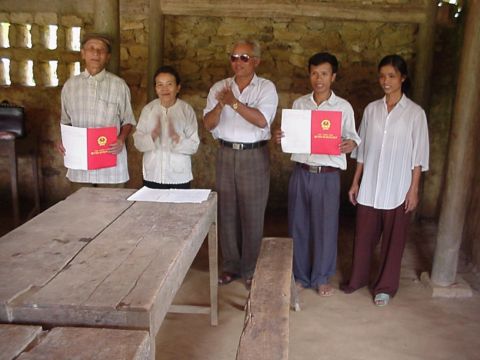
At the end of the 1980ies and as a core element of the doi moi, the Government of Vietnam had allocated the larger part of all the agricultural land in the country to individual farmers, thus kicking off a boost in agricultural production. By the end of the 1990ies, a similar process of allocating forest land to farmers started, hoping for a similar positive effect on forest land. In Quang Binh, the GTZ-supported food security project pioneered this process by supporting the allocation of more than 40,000 hectares of forest land to about 11,000 individual land owners.
The results of the baseline survey of the SMNR-CV in 2004 indicated that the management of forest land distributed to households was still very unsystematic, not planned and not sustainable. Forest protection regulations had only been formally introduced (or imposed), but mostly as a blueprint without the participation of forest holders. Consequently, the regulations were not respected and followed; violations were not sanctioned. In most communes, forest land was allocated to individual households only (not user groups and communities), following mainly the principle of social equity. The official process of Forest Land Allocation had resulted in most people having tiny plots of forest land, rendering effective forest management next to impossible.
|
 |
|
|
Click to enlarge
|
In addition, “red book” titles were often issued for forest plots which had not been demarcated in the field, the new owner not knowing the exact location or boundaries. The resulting potential conflict with the new owners of neighboring plots contributed to a lack of investments into the new property. In the same sense, the subsidies expected from national targeted programs (e.g. 327 or 661 providing seedlings for free or for a very low nominal price) hindered own investments into forest development.
The project concept of the SMNR-CV addresses these problems by three sub-indicators, each of which contains an institutional aspect (issuance of provincial guidelines) and an aspect of widespread application of the innovative methods introduced:
In Quang Binh, improved provincial guidelines are issued
- on forest protection (until 12/2007),
- on forest land allocation (until 06/2008) and
- on community forestry (until 06/2009),
and are applied in all rural districts by the relevant stakeholders in the protection and sustainable management of forest resources.
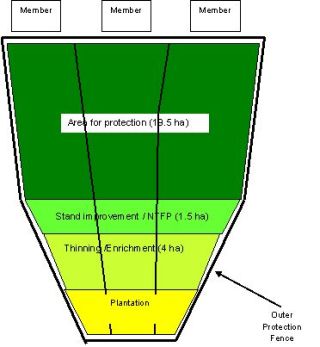
In the project implementation strategy, the three sub-indicators represent a sequence of tasks in the sense that guidelines for forest protection have to be in place and applied before forest land should be allocated to households or user groups. Likewise, community forestry (or more exactly “Community-based Forest Management”, CBFM) only makes sense after households and user groups have received secure land titles.
|
|
|
|
Click to enlarge
|
In early 2008, the method of “Forest Protection and Development Regulations” (FPDR) was issued as the official provincial guideline on forest protection and development, and has since then strongly influenced the revision of the national legislation (Circular 70 of MARD) on this issue. In December 2008, the project manual on “Participatory Land Use Planning and Forest Land Allocation” (PLUP-FLA) was issued as the official guidelines on forest land allocation in Quang Binh. The latest revised version of the project manual on planning and implementation of “Community-based Forest Management” (CBFM) is available since January 2009. This manual documents the current “state of the art” in Community Forestry in Vietnam as well as administrative and technical procedures for the implementation of CBFM. It is hoped to be officially adopted by the provincial authorities by mid of 2009.
In parallel, the application of FPDR is underway in an increasing number of communes in all districts. Since the guidelines on Forest Land Allocation are not yet official, application in the field is still slow and follows conventional procedures or is promoted as PLUP-FLA on a pilot basis in selected communes. As expected, the process of introducing CBFM is the longest and most complex. To speed up this process, the SMNR-CV project has initiated and supported, as from 2005, the establishment of field demonstration models on CBFM application in four of its pilot communes.
|
|
|
|
Click to enlarge
|
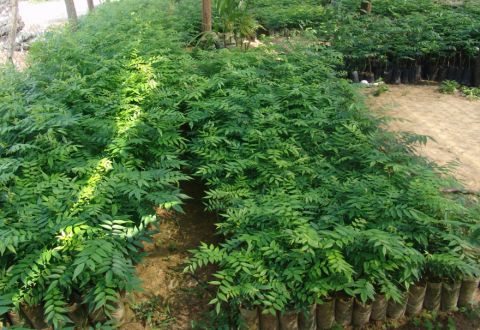
Going beyond the initial project concept, the SMNR-CV project in cooperation with its partners in this work area has carried out a province-wide representative survey on forest small holders. The aims are to establish and later monitor a data base on the availability of ready-to- harvest timber, to assist forest producer groups and associations in receiving group certification of smaller forest stands and to strengthen their position in processing and marketing of their timber.
|
|
|
|
|
|
|
|






)
)
)
)

