Value Chain & Cluster Promotion
|
|
In the SMNR-CV project, the decision on “value chain and cluster promotion” as the general method of choice and on the GTZ-specific toolbox of ValueLinks to promote income generation for rural households and small enterprises has a longer background.
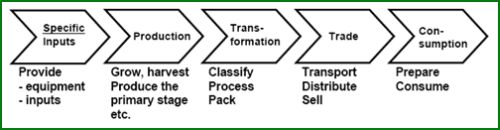
During the years 1996 to 2002, GTZ implemented a predecessor project entiled "Integrated Food Security Programme” (IFSP) in the mountainous districts of Quang Binh Province. The context was that of prolonged periods of hunger and extreme poverty and a rural economy which was still largely subsistence-based with limited marketable surplus of mainly agricultural and forestry primary commodities. The rationale of the IFSP in this field was improving access to food by promoting off-farm income opportunities. The methodological approach was action-oriented and demand-driven, based on the method of MA&D (Market Analysis and Development) which was first developed by RECOFTC (http://www.recoftc.org/site/). Similar to the Value Chain approach, MA&D follows in its analytical and promotional steps products from places of collection and production, extraction and processing to final market destinations (end consumers). In several rounds of field research, including resource base assessments and market studies, the MA&D process delivered a number of outputs of viable products to be promoted. The most promising sub-sectors were then chosen, based on criteria of appropriate low-technology, potential for income generation and poverty reduction and well as for environmental reasons, including natural honey, broom and hat making, pepper, rattan, mushrooms and silk worm (for food).
The SMNR-CV project, as from 2004, has introduced “Local Economic Development" (LED, see sub-section on this website) and its approach of strategic planning as an overarching concept for the promotion of income generation of households and rural SME and for economic development of the project region. The concept was introduced in a series of stakeholder workshops at provincial and district levels which identified, among other the priority sub-sectors to be promoted.
The SMNR-CV, after some research on available instruments, decided on the use of the Value Chain methodology as the most suitable and operational instrument for the upgrading of production, processing and marketing of the products selected during the LED process. The VC methodology adopted by the SMNR-CV was a set of pro poor Value Chain tools developed by GTZ, which later became branded as “ValueLinks”. ValueLinks has been developed by GTZ as its specific, action-oriented approach to the pro-poor oriented promotion of value chains. The ValueLinks methodology builds on lessons learned with rural development programmes and private sector promotion supported by GTZ. It structures the know-how of value chain promotion into 11 modules organised according to the project cycle.
|
 |
|
After receiving a formal training on the application of ValueLinks, the project team launched a series of stakeholder workshops for the analysis of specific value chains. Based on previous studies, major bottlenecks and constraints were identified which hindered the extension and further development of these sub-sector. Apart from technical issues, these constraints mainly included poor business linkages and cooperation among local producers, input suppliers and service providers and, most importantly, a lack of management and marketing knowledge. Based on these analyses, up-grading and facilitation strategies were formulated and implemented.
Currently, the SMNR-CV facilitates the upgrading of value chains and production clusters in the following sub-sectors:
- Natural Honey (Apiculture)
- Raw Silk (Sericulture)
- Pepper
- Selected support in other sub-sectors (rubber, mushrooms, rattan and wood processing)
To further promote the application of the ValueLinks approach, the SMNR-CV project initiated the foundation and continues to support the operations of a provincial “Value Chain Group” which consists of representatives of relevant line departments, public and private service providers, representatives of producer groups and associations and a number of donor-supported development projects. Members of the group have received several trainings on the methodology of ValueLinks and its application. In 2006, an introductory seminar was organized by the SMNR-CV. In 2007, members of the group participated in a training organized by the GTZ-SME Development Program in Hanoi. The most recent seminar took place in October 2008 in Quang Binh.
|
|
|
|
|
|
|
|
|
|
|
|
|
|