Participatory socio-economic development planning
|
|
|
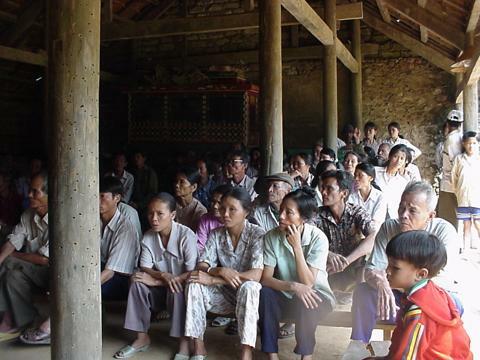
The development, piloting and larger scale application of participatory planning methods at the local level dates back well before the inception of the SMNR-CV project. In GTZ-supported projects in Vietnam, it was first applied by the “Social Forestry Development Project” (SFDP) in Song Da, carried out by GFA from 1993 to 2004.
|
 |
|
|
Click to enlarge
|
In the project area in Central Vietnam, the predecessor “Integrated Food Security Program Quang Binh” (IFSP) based its planning of village development programs during the first phase (1996 to 1999) on the method of “Participatory Rural Appraisal” (PRA). In its second phase, the toolkit of PRA instruments was enlarged, and – parallel to the development in the SFDP – the output of the planning process became a more comprehensive “Village Development Plan”.
|
|
|
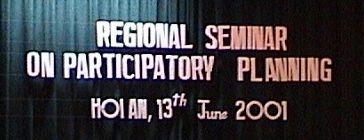
The participatory method of “Village Development Planning” (VDP) was disseminated by both GTZ projects; among other measures by a regional seminar with the attendance of planning departments from 9 provinces and the Central Institute of Economic Management (CIEM) of the Ministry of Planning and Investment (MPI). The seminar was a starting point of a nationwide “VDP Network” of practitioners of participatory planning methods and has influenced several revisions of the national legislation on decentralized planning.
|
|
|
|
Click to enlarge
|
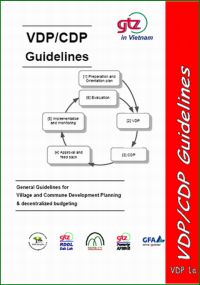
By the year 2004, towards the end of the IFSP and at the beginning of the new SMNR-CV project, the group of GTZ-GFA projects promoting VDP was joined by the “Rural Development Project Dak Lak” (RDDL). For the planning cycle of 2004, the planning method itself was enlarged by the aggregation of planning data from micro level (villages) on the level of communes and become renamed “Village and Commune Development Planning” (VDP-CDP). Since communes are the lowest formal administrate level in Vietnam, this conceptional step opened up, for the first time, the possibility to officially integrate the data of the Village and Commune Development Plans into the conventional (top down) planning procedures of the provincial planning authorities. A joint effort was therefore made by the three projects and the GTZ-supported “Poverty Action Program 2015” to elaborate and publish a comprehensive training manual in VDP-CDP as well as to develop a specific software for data management, analysis and reporting on the implementation of the plans on local levels.
|
|
|
|
Click to enlarge
|
For the SMNR-CV project, an important milestone in the dissemination of the VDP-CDP method was the interprovincial workshop held in Hue in December 2004 with the attendance of 9 provinces from the Central Region, the MPI and a large number of donor-supported projects. As a direct outcome of this event, the Provincial People’s Committees in the provinces of Quang Binh, Quang Tri and Hue formally established by decisions so-called “Provincial VDP Working Groups” in their Departments of Planning and Investment (DPI). In each of the provinces, the groups were to implement participatory planning exercises at local levels, based on the VDP-CDP method in selected pilot districts. A number of donor organizations, multi- and bilateral projects pledged to support these pilot exercises, among the larger investment project of the ADB (Central Region Livelihood Improvement Project) and several rural development projects of the IFAD, Sweden, Norway and Switzerland.
In the planning cycles of the following next two years, the wide acceptance of the new planning method has made VDP-CDP a “GTZ trade mark” among planning departments and donor-financed projects in the North-Central region. Pilot implementation in 2005-2006 covered all communes in the selected pilot districts in Quang Tri and Hue and another 5 districts in Quang Binh (in total more than 500 villages). Other donor-supported projects have adopted and further developed and up-scaled the application of the method. In all three provinces, “VDP support groups” were operational under the leadership of the provincial DPI. However, the implementation of the local development plans remained heavily dependent on finance provided by donor support.
A self-critical assessment of the impacts of the VDP-CDP method in the beginning of 2007 concluded that the participatory planning method was actually used as a reference for investment decisions of several larger scale loan and TA projects. These needs-based investments in rural infrastructure and services significantly contributed to improved living conditions and avoided misallocations of scarce resources. The outputs of the participatory planning process on the village and commune levels have also been partially used to draft the 1-year and 5-year provincial socio-economic development plans. A big challenge, however, remained the full integration of the VDP-CDP method into the conventional Socio-economic Development Planning (SEDP) and an official recognition of the method by the provincial authorities (PPC), including a firm commitment to finance the large scale application of the innovative method and to use its outputs for investment decisions on public budgets.
In close collaboration with the provincial planning authorities (DPI) of Quang Binh, the VDP-CDP method was therefore revised and simplified during the first months of 2007, thus bringing it in line with the administrative requirements and own financial means of the department, district and commune authorities. The major streamlining and cost-saving effect came with the shifting of the participatory planning exercises from the village to the commune level (with the active participation of representatives of all villages). Thus, the core elements of the participatory planning approach were maintained, while on the other hand the application of the method became manageable by the local authorities with their own budget means. To further increase local ownership, the label of the method was changed from VDP-CDP (perceived as donor-driven) into “Participatory Socio-economic Development Planning” (SEDP).
With approval of the Provincial People’s Committee, the revised method of participatory SEDP was applied in the planning cycle of 2007 on a pilot basis in all 85 communes in 4 out of 7 districts of Quang Binh. The encouraging outcome of the pilot application was that the commune development plans not only expressed the needs of local people, but could be aggregated on district levels and thus integrated into the annual provincial development plan. Contrary to conventional planning, the participatory process is documented in minutes of commune and district meetings. The expressed needs are documented in table forms on investments needs (mostly infrastructure) and public service delivery. These forms are aggregated and forwarded to district and provincial levels and constitute a reference for the allocation of public budgets.
|
|
|
Based on this positive assessment, the Provincial People’s Committee of Quang Binh issued a decision in June 2008, rendering “participatory SEDP” the official and mandatory planning method in the province. Consequently, the previous draft version of the guidelines on the method was finalized and applied in the planning cycle 2008. The annual planning covered all 159 communes in all 7 districts of the province and was largely successful, except in about 15 remote communes in the newly included 3 district in which the participatory stakeholder meetings were either not yet properly carried out or not well documented. In order to overcome these remaining issues and to consolidate the application of the method, some additional trainings will be supported by the SMNR-CV project in selected districts in 2009.
|
|





)
)
)
)

