
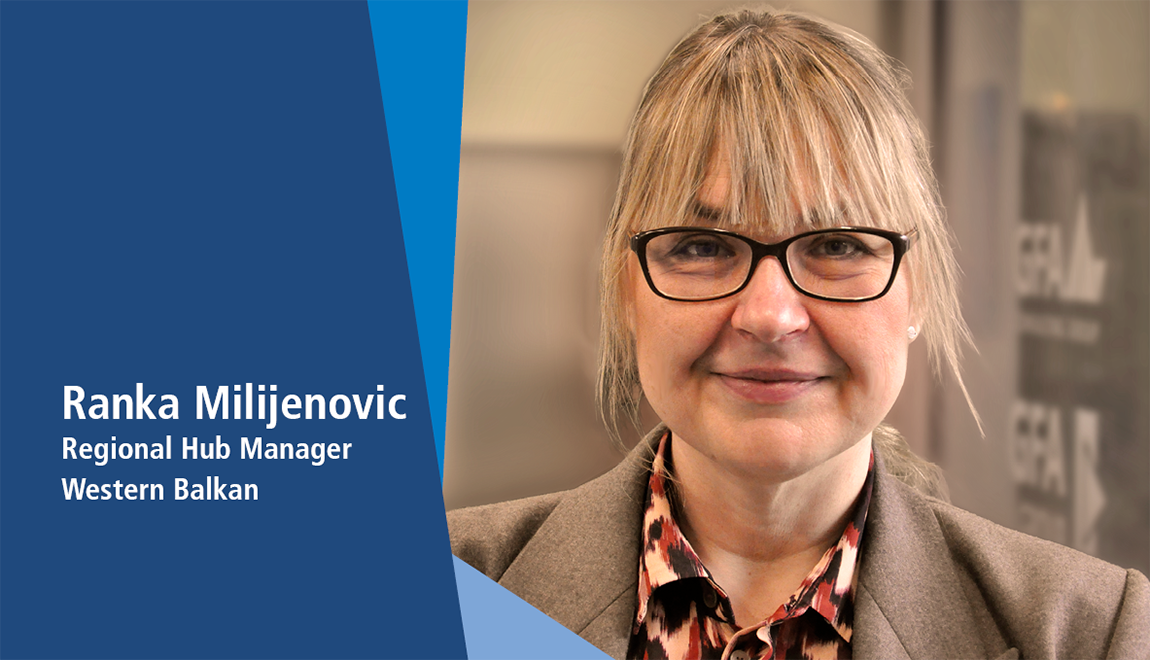
Interview with Hub Manager Ranka Milijenovic: “In the region, GFA is associated with professionalism, reliable implementation and good project results”
In February 2026, Ranka Milijenovic became Regional Manager for the newly established GFA Hub Western Balkans, Eastern Europe, and Central Asia. As a senior professional with over 20 years of experience in development cooperation, public policy, and EU-funded programmes, Ranka has worked across national, regional, and European assignments. In this interview, she speaks about her first months in her new role and her plans for the Belgrade-based GFA Hub.
Ranka, before you started your job as hub manager, you were familiar with GFA from earlier working contexts. What new impressions and experiences have you gained so far in your new role regarding GFA and its work?
As you mention, I already knew the company from previous working contexts, and I already had a positive impression of its professionalism and technical expertise. In my current role, this impression has become much broader and more specific: Today, I see GFA as a large, well-structured organisation whose work is based on solid internal systems and capabilities. I particularly appreciate the opportunity to work with different departments and colleagues. Also, I have gained a very positive impression of the attention GFA pays to its employees, especially through onboarding, supervision, and the willingness of colleagues to share knowledge. At the same time, I have learned that in such a decentralised organisation, effective cooperation requires proactive communication, clear roles, and continuous alignment. This is where the newly established hub is adding real value by connecting local and regional knowledge with GFA’s wider technical and institutional capacities.
Please share with us some insights on how you are organised in the hub team and what kind of tasks you have to cope with?
The hub team is currently just two people, a project manager and me as hub manager. Given the small team size, we are organised in a very hands-on and flexible way, with a clear division of main responsibilities but close cooperation in daily priorities. Right now, we are managing five ongoing projects, in some of which I am directly involved in, in addition to my hub management responsibilities. Also, we are involved in several acquisitions, which includes coordination with technical departments, consortium partners, experts, and internal support functions. Overall, the current set-up requires strong prioritization and regular internal coordination.
You mention being involved in tasks such as project acquisition. How has this double role with its mix of management and operational tasks worked for you in recent months?
This double role has worked quite well for me so far. Given the current size of the hub, the overall workload is still manageable, and being directly involved in project management and acquisition has been very useful. It has helped me get to know different departments, colleagues, internal processes, and procedures much faster and in a much more practical way. I also see this as an important learning process because the knowledge and experience I am gaining now will make it easier to structure work and transfer knowledge as the hub gradually expands.
Tell us a bit about the feedback you get from the network of possible partners and donors in the region: How do they see the GFA Hub, and how important is our regional presence for local networking and project management?
The feedback from local and regional stakeholders has generally been very positive. GFA as a company is associated with professionalism, reliable implementation and good project results, and this reputation is well recognised among regional beneficiaries and partners. At the same time, GFA has had a presence in South East Europe for more than ten years through GFA SEE. In my view, the hub is an additional dimension of this presence, not replacing what already exists, but strengthening it through closer day-to-day contact, better visibility, and more systematic networking. This can also support GFA in opening opportunities in new thematic areas and with additional donors in the region, combining GFA’s wider technical expertise with stronger local intelligence and partnerships.
What are your plans for the further development of the hub? How will it expand, with more people working there? And what does the collaboration with GFA SEE under one roof actually look like?
The top priority is to strengthen the hub team by hiring another project manager, a process that is already underway. Since the beginning of the year, the hub is responsible for three new projects, and I hope this positive trend will continue and create the basis for further expansion, possibly with one more project manager by the end of the year. The aim is to build enough capacity to respond to growing demand from technical departments, not only for project management support, but also for local and regional knowledge, partner networking and operational presence. Cooperation with GFA SEE works very well: Working under the same roof allows for close day-to-day coordination, informal exchange and use of complementary regional experience. I consider this set-up to be very valuable, as GFA SEE adds credibility, a long-standing regional presence, and continuity to the GFA Hub Western Balkans, Eastern Europe, and Central Asia.


