
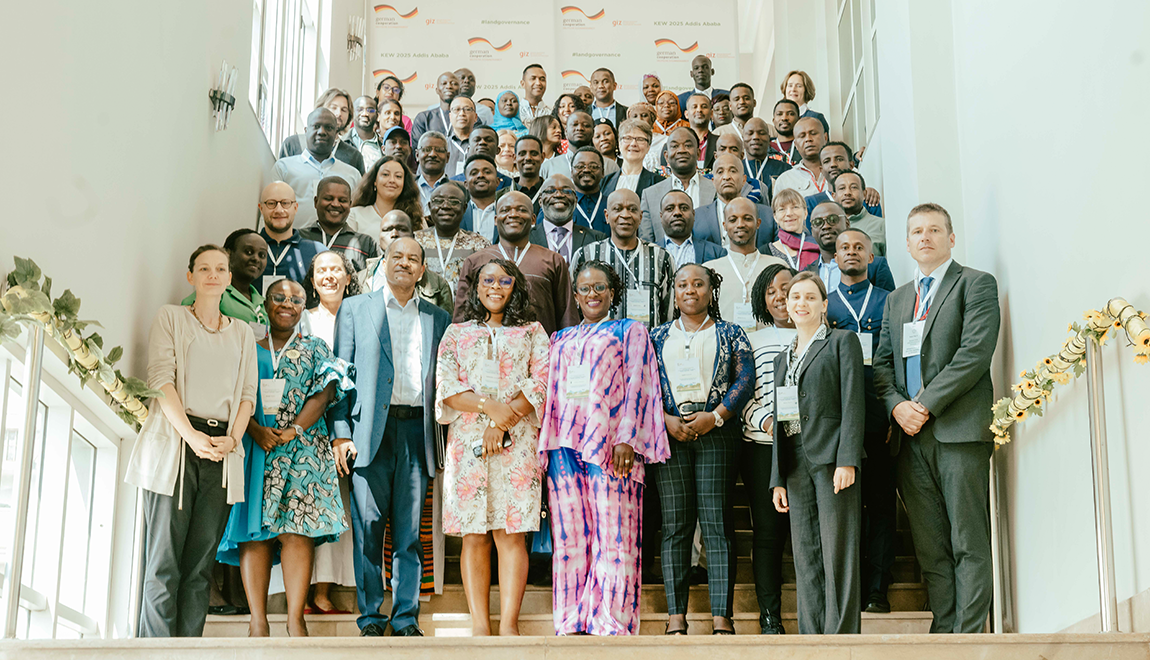
SUCCESSFUL CONCLUSION: STRENGTHENING LAND GOVERNANCE NETWORKS AND CAPACITY EXCHANGE
Under the Global Programme Responsible Land Policy (GPRLP), GFA Consulting Group was commissioned by GIZ to design and implement a bilingual, multi-country knowledge exchange and capacity development architecture to strengthen land governance actors and civil society in Sub-Saharan Africa. Active in seven partner countries, the project combined Knowledge Streams, a CSO Blended Learning Programme, regional workshops and practical knowledge products. Its objective was to improve land access and promote responsible land governance systems by enhancing institutional capacities, peer learning and structured civil society participation.
Through two cycles of thematic Knowledge Streams, more than 200 practitioners from government, CSOs, academia and the private sector engaged in exchange on conflict-sensitive land registration, responsible investment, climate-responsive land governance and multi-stakeholder platforms. Evaluations show strong uptake: 82% of respondents applied lessons in their professional context and 80% shared insights within their organisations. As one participant noted, “I will use the tools and approaches shared to advocate for better land governance in my area.”
The CSO Blended Learning Programme strengthened advocacy, partnership-building and resource mobilisation capacities. Participants highlighted the value of evidence-based approaches and practical tools. One CSO representative stated, “I expect to use what I have learnt in this course to improve our advocacy by involving communities more, using real data to guide actions, and working closely with local leaders to push for land rights.” Eighty percent confirmed that the training significantly enhanced their organisation’s engagement in responsible land policy processes.
By combining regional peer exchange, digital learning, coaching and face-to-face workshops, the project established sustainable learning mechanisms and reinforced civil society’s role in shaping inclusive, accountable and gender-responsive land governance systems.


