|
|
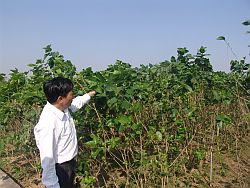
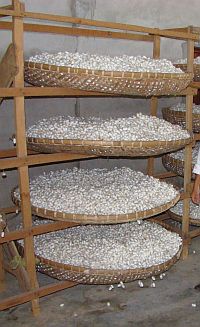
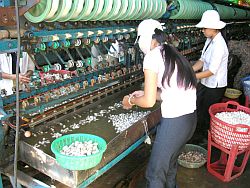
In the value chain (VC) of the silk production industry (or sericulture), raw silk is the final product of the local cluster of mulberry plantation, silkworm rearing and cocoon reeling in some 10 lowland communes of Tuyen Hoa district.
It was chosen as one of the value chains supported by the SMNR-CV project for several reasons: high demand for raw silk in the domestic and export markets; potential for income and employment generation focused on for rural poor women; high rate of return on investment by rural households in the localities; processing capacity for the very perishable intermediate product of silk cocoons (two small privately owned reeling factories) already installed and operational. In addition to economic and social considerations; mulberry plantations contribute to the reinforcement of river banks and thus to the ecologically sustainable management of local natural resources.
|
 |
|
In early 2006, an upgrading strategy for the sub-sector was developed in cooperation with all stakeholders. The main elements of the strategy included: i) production extension and intensification to build up self-sustaining industrial cluster; ii) vertically diversify the activities downstream the value chain to gain more value-added and to be more independent of external traders. Later in mid of 2007, these strategies were adjusted to the new market condition, and the new strategy is VC restructuring for higher competitiveness. Since 2006, several rounds of technical training courses were held for sericulture farmers. A mulberry variety with higher productive was introduced and has been used to replant degraded old plants. Further downstream in the chain, the processing capacity of the reeling factory was increased with support of the Private-Public Partnership (PPP) cooperation project with DED. The SMNR-CV project facilitated the establishment of the district sericulture association to strengthen the linkages amongst farmers-farmers.
|
|
|
Significant outcomes of the upgrading strategy are so far:
- Up to 1,000 farmer households are engaged into the local sericulture cluster;
- Necessary infrastructure for the industry has been developed and nurtured with the new variety mulberry field scattered in all communes and reeling facility at the heart of the cluster.
- Institutional structure is better organized with the established association of farmers and marketing contracts between farmers and reeling factories.
|
|
|
Since mid 2008, it has become evident that the silk industry in Vietnam is undergoing a significant structural change. With suppliers from China entering the market, the price of raw silk and the price for the cocoons supplied by farmers in the project region has decreased by about 20% which has led a number of households switching to other cash crops. With the support from local authorities the SMNR-CV project has assisted the sericulture association in formulating a strategy and action plan to restructure and consolidate the local production with the aim to re-gain its cluster competitiveness. Critical issues are, among others, the improvement of silkworm hatching and rearing techniques to achieve a more harmonized quality standard.
|
|
|
|
|
|
|
|