Community-based Forest Management (CBFM)
|
|
|
The term community forestry normally refers to a form of forest management in which entire village communities are handed over (allocated) long-term user rights over state forest resources and are protecting, sustainably managing and utilizing forest resources for their environmental benefits and as contribution to their livelihood development. In the context of Quang Binh province, forest land has been almost entirely allocated to individual households resulting in rather small forest plots under one land use certificate per household, rendering the management, protection and monitoring of such fragmented forest patches extremely difficult. Under these circumstances, the formation of forest user groups with joint planning, reporting and approval procedures is a practicable management concept. This concept of individual ownership but joint management and protection is referred to as Community-based Forest Management (CBFM).
|
 |
|
|
Click to enlarge
|
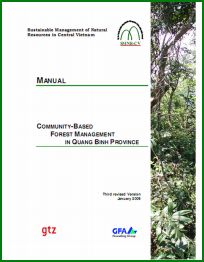
The SMNR-CV project has, in collaboration with its partners in the forestry sector, developed a practical manual on CBFM. The most recent version of the manual, as of January 2009, reflects the specific situation in Quang Binh province and provides i) an introduction to the concept of CBFM and ii) technical as well as administrative procedures for facilitating CBFM planning procedures together with the local population.
The planning procedures as described in the manual are only part of a participatory planning process starting with the development of Forest Protection and Development Regulations and Forest Land Allocation. The manual therefore builds on the outcomes of previous planning procedures to be completed before CBFM can be initiated.
CBFM is relatively new to Vietnam and especially to Quang Binh province. Therefore, CBFM has been carefully piloted and monitored over the last years in order to assess its potential to strengthen forest management, including forest development and forest protection, while at the same time increasing people’s (legal) benefits from the forest resources they manage. CBFM, as presented in the manual is based on the following basic principles:
- Participatory - an independent follow-up of planning procedures can only be expected if the people concerned have been fully involved in all decision-making processes and fully understand the planning results. If people do not develop a self-interest in forest management and a sense of ownership in the decision-making process, implementation will be half-hearted, probably misunderstood and will more likely fail.
- Simple – to allow everybody to understand what is happening and to be able to do it.
- Cost-effective – to ensure that locally available resources are sufficient to implement CBFM procedures.
- Relevant – to ensure that CBFM planning produces only information which is really needed for forest management.
- Strengthen the sustainable management of forest resources while mitigating potential negative impacts.
- Reflect local peoples’ needs to access and use forest resources (and not merely focus on forbidding the extraction of forest products).
- CBFM can only be sustainable if procedures are in line with the current legal policy framework.
The CBFM manual is written as a tool for those who will work with villagers in developing, elaborating and implementing their CBFM plans. This can be project staff, extension workers or staff from supporting agencies of the district and/or commune level who act as facilitators and support local villagers in CBFM.
Depending on the local situation, different organizations can take the initiative and facilitate CBFM in the field. Organizations at the district level such as the Office of Natural Resources and Environment (NREO), the Forest Protection Unit (FPU) and the Economic Division can provide support and facilitate local people in the development and implementation of CBFM plans in cooperation with staff at the commune level and with overall backstopping support from the provincial level.
In parallel to the continued revision of the CBFM manual, the SMNR-CV project has organized a series of training courses its partners and target groups on the new method of “Participatory Forest Inventory”, on the use of GPS technology and on silviculture techniques. As from 2005, the project has initiated and supported the establishment of field demonstration models on CBFM application in four of its pilot communes. After almost four years of implementation, these CBFM models have shown rather positive results for all four different forms of forest use.
|
|
|
|
Click to enlarge
|
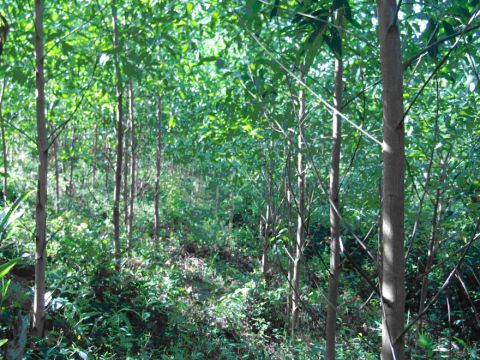
The area for new forest plantation using varieties of Acacia has developed very well; trees are above 4m high and develop strongly without being affected by pests and diseases. The varieties of Acacia have a short circle (6 – 7 years), which helps the user-group to improve household incomes and reinvest into forest development using other indigenous trees with a longer production cycle. It is estimated that the area of planted forest will be ready for harvest by 2010 with a yield of timber of up to 120m3.
|
|

|
|
Click to enlarge
|
The area for stand improvement with non-timber forest products: The NTFPs selected for the model are varieties of rattan, especially May tat (Calamus tetradactylus Hance). It has become evident that rattan is particularly suitable for the micro-climatic conditions and the geographical formation of the model, when under the canopy of the current forest. So far, rattan develops strongly and has grown to a height of 2m.
|
|

|
|
Click to enlarge
|
For the area for enrichment planting with indigenous trees, the following species of indigenous trees were selected for the models: Tram huong (Aquilaria crassna), Lat Hoa (chukrasia tabularis A.Russ), Hue (dalbegia tonkinesis). So far, indigenous trees in the models develop rather well. In this area, silviculture techniques are applied including selected thinning of non-useful trees, clearing shrubs and bushes to have space for useful trees to develop, and planting extra indigenous trees under the canopy of the forest.
|
|
|
|
Click to enlarge
|
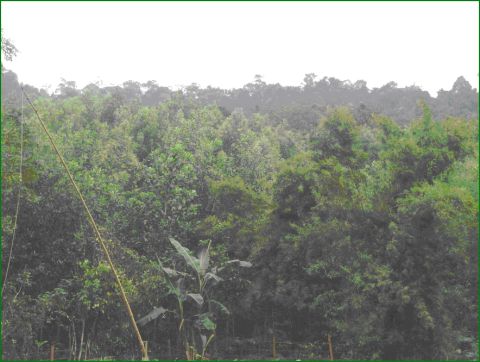
After implementing forest protection activities in the area of natural forest, members of the user group became more aware of the economic value. They started safe-guarding their forest against illegal exploitation of other local people and notably against the penetration of free roaming cattle into the models. After several of such incidents in the beginning, the damage of which had to be compensated for, no further such penetration was reported. The natural forest is on a satisfactory way to regeneration.
|
|






)
)
)
)
)

