|
|
|
|
Click to enlarge
|
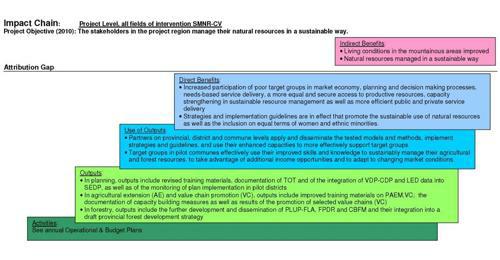
The logic of the overall Impact Chain, bottom-up:
- Activities and their estimated costs are annually planned and documented in Operational Plans, 3 to 6 months work plans and implementation agreements with partner organizations. Recent examples of these plans can be found in the download section.
- In each of the work areas, the implementation of the planned activities leads to verifiable outputs. Implementation of activities and evidence of timely outputs are subject to project-internal quarterly monitoring and half-yearly M&E workshops with all major partners and the PPC as the project owner. Corrective action, if any, is discussed and included in the follow-up plans.
- Use of outputs indicates to what extent partner organizations have integrated the innovate methods and models into their guidelines and standard procedures (institutionalization) and widespread application (roll out). For the target groups, it would indicate to what extent newly introduced practices have been adopted in every day routines by rural households and small enterprises.
- Direct benefits include tangible, but also the not so easily quantifiable advantages that the project brings to the stakeholders. These would include increased incomes (or reduced poverty) on the side of the target groups, but also improved participation in decision making processes and improved skills to participate in a changing market economy, while maintaining the potential of natural resources for the next generation. For the intermediate partner organizations, the availability of innovate tools and mechanisms for improved service delivery in needs-based and market oriented planning, agricultural extension, forestry and income generation are seen as direct benefits enhancing local economic development.
- Since the relatively small technical assistance project is not the only, and not even the most important driver of change in the province, it can only contribute to a limited extend to the higher aggregated impacts of improved living conditions and sustainable management of natural resources. There is thus an attribution gap between the direct effects of the project and the indirect benefits it hopes to achieve.
In addition to the overall logic above, specific impact chains apply for each of the work areas of the project. Apart from a cross-cutting indicator (poverty reduction in the pilot communes), the direct benefits in each work area are measured by specific impact indicators.
|
 |
|
Cross-cutting Indicator:
In the pilot communes supported by the project, the percentage of households below the poverty line decreases annually by at least 4.5% (referring to data of DOLISA according to new poverty definition of 2006).
Specific Impact Indicators:
Work Area 1: Participatory socio-economic development planning (SEDP)
Until 12/2009, participatory methods for socio-economic development planning (SEDP) are officially recognized by provincial guidelines and applied in all rural communes and districts in the core province of Quang Binh.
Work Area 2a: Participatory Agricultural Extension Method (PAEM)
Until 12/2009, participatory methods for agricultural extension (PAEM) are officially recognized by provincial guidelines and applied in all rural communes and districts in the core province of Quang Binh.
Work Area 2b: Value Chain and Cluster Promotion
In the intervention areas, the additional net income of households and small enterprises involved in the promotion of value chains increases by at least 10% annually.
Work Area 3: Community Forestry
In Quang Binh, improved provincial guidelines are issued
on forest protection (until 12/2007),
on forest land allocation (until 06/2008) and
on community forestry (until 06/2009),
and are applied in all rural districts by the relevant stakeholders in the protection and sustainable management of forest resources.
|
|
|
|
|
|
|
|
|
|
|
|
|
|






)

