|
|
Click to enlarge
|
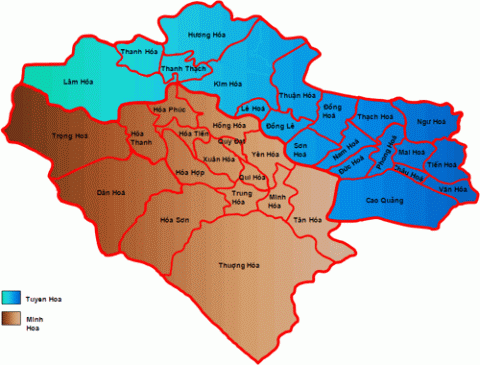
Towards the end of the first implementation phase, project activities and their monitoring became more focused on the pilot communes as well as on the overall impacts on the provincial level. Thus, the area-based M&E system became less useful. Instead, regular data collection, surveys and the follow-up of milestones for the achievement of the impact indicators now constitute the core elements of the M&E system.
Impact Monitoring
At the beginning of the first phase, a major baseline survey on a number of socio-economic indicators was carried out to document the status quo before project intervention. At the end of the phase, it was used by the mid-term progress review mission as a reference to quantify the achievements with respect to selected indicators, such as increased household income of the target groups, participation in planning processes, the rate of poverty, agricultural and forestry practices.
With the introduction of the impact indicators for the second implementation phase, milestones were formulated as a kind of stepping stones on the way to the fulfillment of these indictors. For each work area, these milestones and their timely achievement are documented in the annual Operational Plans and become binding elements in the implementation agreements with the partner organization. Examples for the year 2008 are:
Milestones for 2008
Work Area 1: Participatory socio-economic development planning (SEDP)
- By 03/2008, a provincial workshop is organized on the lessons learnt from the pilot application of the participatory SEDP in the 4 districts.
- By 05/2008, PPC QB has issued a decision which officially recognizes the participatory SEDP concept and provides guidelines for the application in all communes and districts of the province.
- By 09/2008, the participatory SEDP concept is applied in all communes of 7 districts/city of the province.
Work Area 2a: Participatory Agricultural Extension Method (PAEM)
- By 06/2008, PAEM is applied and evaluated in at least 3 communes in each of the 7 districts, totaling at least 21 communes.
- By 09/2008, participatory methods for agricultural extension (PAEM) are officially recognized for compulsory application in all rural communes and districts in the province by a decision of the director of DARD.
- By 12/2008, PAEM is applied in at least 40% of all communes in the 7 districts, totaling at least 63 communes.
Work Area 2b: Value Chain and Cluster Promotion
- By 06/2008, at least 01 additional suitable Value Chain / sub-sector is identified (in addition to one identified in 2007), for starting the application of Value Chain promotional activities;
- By 09/2008, the Apiculture Associations of Tuyen Hoa and Minh Hoa districts are able to manage and operate independently, without further support from the project;
- By 12/2008, a representative survey among households and SME involved in the promoted VC of apiculture, sericulture and 01 additional suitable Value Chain indicates that their additional net income from these activities has increased by at least 10 % in the year 2008.
Work Area 3: Community Forestry
- By 03/2008, the application of Circular 38/2007/TT-BNN is integrated in the methodology of participatory land use planning (PLUP) and forest land allocation (FLA), and the integrated methodology of PLUP-FLA is institutionalized by 03/2009.
- By 8/2008, forest protection and development regulations (FPDR) are applied in all communes of at least 04 districts of Quang Binh.
- By 03/2009, provincial guidelines are issued on the application of “community-based forest management” (CBFM), and are applied in at least 02 districts of Quang Binh.
Apart from the project-internal monitoring, external evaluation tools are commonly applied in projects supported by GTZ. For the SMNR-CV project, this included the application of e-VAL in May 2005 and again in May 2007 which confirmed that a large majority of partners and target groups appreciated the achievements of the project as a success. Towards the end of the first implementation phase, the mid-term project progress review mission basically re-confirmed these encouraging findings and formulated in their report a number of suggestions to re-focus the concept and the organization of the project implementation for the second phase.
|







)

