
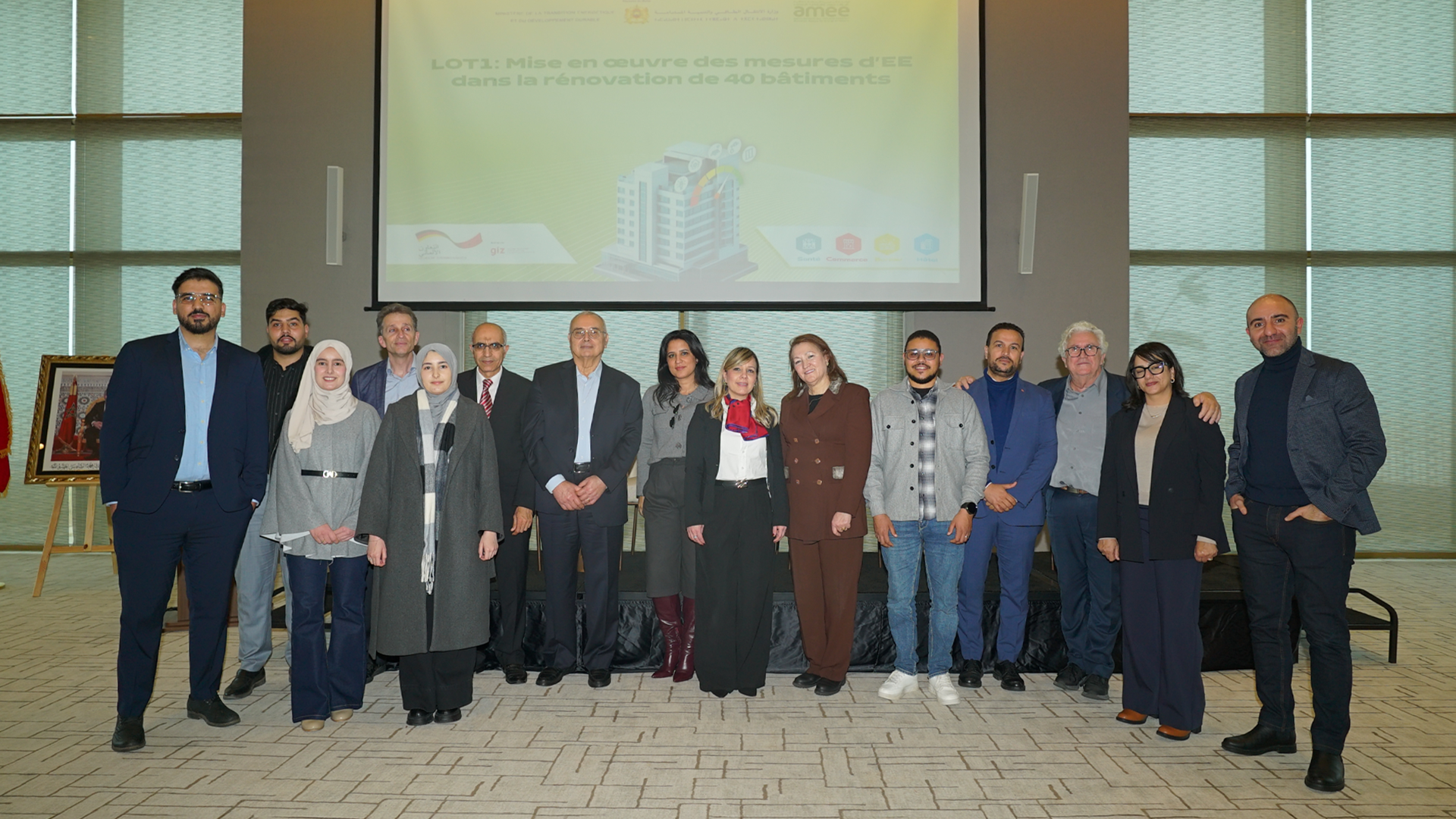
 © GFA | The technical assistance team from GFA Consulting Group and Energy Handle
INTEGRATION OF ENERGY EFFICIENCY INTO THE RENOVATION OF PRIVATE TERTIARY BUILDINGS IN MOROCCO
Led by the Ministry of Energy Transition and Sustainable Development (MTEDD), implemented with AMEE and supported by GIZ and financed by the German Federal Ministry for Economic Cooperation and Development (BMZ), GFA Consulting Group carried out the technical assistance in partnership with Energy Handle and has supported 41 building managers in four sub-sectors: the offices, retails, hotels and healthcare sectors.
The tertiary (commercial and public service) building sector represents a major strategic lever for controlling energy consumption and reducing greenhouse gas emissions. Characterised by a wide range of uses - healthcare, retail, offices, and hospitality - it offers significant potential to improve energy performance, particularly through the renovation and upgrading of the existing building stock.
In response to these challenges, GFA Consulting Group with his local partner Energy Handle carried out the technical assistance project dedicated to integrating energy efficiency (EE) into the renovation of tertiary buildings. Its purpose is to support private tertiary building managers in systematically adopting energy-efficiency and renewable-energy solutions within their renovation projects, while taking into account the technical, economic, and operational specificities of each building type.
The project's overarching objective is to reduce energy consumption and the associated greenhouse gas emissions in tertiary buildings, with a particular focus on the healthcare, retail, office, and hotel sectors. The technical assistance is structured on six complementary work packages from energy audit and technical support for the implementation of energy efficiency and renewable energy integration measure:
- Support for the introduction of energy management systems at the building level to ensure sustainable monitoring of energy performance.
- Development of an effective national approach for energy renovation of tertiary buildings, covering both the private and public sectors.
- Development of representative typologies of tertiary buildings adapted to the six climatic zones of the Kingdom.
- Development of a decision-support tool for techno-economic assessment.
- Selection of energy renovation scenarios.
- Communication and awareness-raising on energy efficiency, through workshops, video capsules, sectoral guides, and brochures dedicated to EE financing mechanisms.
This experience confirms that energy efficiency is a key lever of the energy transition, serving both economic performance and the decarbonisation of the building stock.
> Learn more about the project.


